12 November 2025
Enforcement of a Court Decision in Germany
Our lawyers can help you with the process of enforcement of a court decision in Germany. Contact us for complete legal assistance.

The enforcement procedure is the last phase of the civil trial in which a creditor may achieve the rights settled by a court decision. If the debtor does not voluntarily comply with the obligation established by a court or a title, it brings out the enforcement proceedings. The German Law provides that it may be enforced obligations whose object is to pay a sum of money, a good or its fruits, bank accounts or may be taken any other measures permitted by law.
Below, our German debt collection lawyers provide an overview of the procedure related to the enforcement of domestic and foreign court orders.
Conditions to enforce a court order in Germany
The main condition to enforce a court order in Germany is for the creditor to have an enforceable document in this sense. This can be represented by:
- a final judgment that is no longer subject to review;
- a judicial settlement;
- an enforcement order;
- a notarial deed.
| Quick Facts | |
|---|---|
| Court decision enforcement legislation | – Civil Procedure Code for domestic orders, – several international treaties for foreign ones. |
Available decision-making procedures | – issuance of court orders, – issuance of judgments. |
Enforcement conditions in debt collection in Germany | The creditor has a final judgment/court/enforcement order or a judicial settlement. |
| Phase of the enforcement order in the debt recovery procedure | This is the final step in recovering a debt in Germany. |
| Asset discovery availability (YES/NO) | Yes, asset discovery may be used to ensure a court order may be enforced. |
| Available enforcement procedures | – attachment of goods or other assets, – statement of assets, – coercive actions, – forced sale, – receivership. |
| Attachment of goods procedure | The procedure implies the seizure of various goods of the debtor. |
| Other assets that can be seized through a court order | – bank accounts, – money from various income sources. |
| Coercive actions | In debt collection, coercive measures imply ensuring the assets are surrendered by the debtor. |
| Types of assets that can be seized through court orders | Immovable property and movable goods (cars, works of art, jewelry). |
| Restrictions on goods that can be attached to orders (if any) | Yes, goods that ensure a minimum living standard for the debtor cannot be used to complete the recovery procedure. |
| Availability of mortgage measures as part of the enforcement procedure (YES/NO) | Yes, a compulsory mortgage (Zwangssicherungshypothek) can be registered in the land register at the creditor's request for claims over EUR 750 (Sections 866 and 867 ZPO). |
| Courts in charge of issuing enforcement orders | Local courts. |
| Other authorities involved in court enforcement proceedings | – banks, – the Land Register. |
| Support in enforcement of court orders (YES/NO) | Yes, our debt collection lawyers in Germany assist with enforcing court orders/judgments. |
| When can a court decision be enforced in Germany? | Once it is final or has been declared provisionally enforceable (Sections 704, 708 and 709 ZPO), as first-instance judgments usually are. |
Can arbitrated settlements be enforced in Germany? (YES/NO) | Yes, such settlements can also be enforced. |
Can settlements reached between the parties’ lawyers be enforced? (YES/NO) | Yes, these are also recognized under the German legislation. |
| Can notarial deeds be enforced? (YES/NO) | Yes. |
| Who enforces court decisions in Germany? | The bailiff is in charge of court order enforcement. |
| Are there costs associated with the enforcement of orders? (YES/NO) | Yes, various fees apply, depending on the type of procedure used. |
| When can enforcement measures start? | Only after the creditor enters into possession of the enforcement order. |
| Can loan-type debts be subject to court order enforcement? (YES/NO) | Yes. |
| Effects of enforcement orders in the case of debtors | The assets of the debtor are confiscated for the repayment of the debt. |
| Effects of enforcement orders in the case of creditors | The creditor can use the confiscated assets to recover losses incurred with the debt. |
| Effects of enforcement orders in the case of other parties | Third parties can no longer be required to pay the debtor and must reach an agreement with the creditor instead. |
| International conventions for the enforcement of judgments Germany is part of | – the Brussels Ia Regulations applicable to civil and commercial matters, – the Lugano Convention, which extends the enforcement of judgments to Denmark, Norway, Iceland, and Switzerland, – the Hague Convention. |
| Possibility to appeal an enforcement order (YES/NO) | No, however, the debtor can contest the method through which the order is enforced. |
| Availability of limitations on enforcement orders (if any) | There is a limitation on excessive attachment, so the creditor can only recover the debt and costs associated with it. |
| Time frame to enforce a foreign court order (approx.) | 2 to 8 months, depending on the country where it was issued. |
For enforcement orders, provisional attachment orders, and interim orders, a court certificate of enforceability is only necessary in extraordinary circumstances. Additionally, only once the document has previously been served may the enforcement procedure commence.
Please note that according to Section 197 of the Civil Code, claims that are no longer subject to appeal and claims based on binding agreements or deeds have a 30-year statute of limitations. During that time, the creditor has the right to start enforcement actions whenever they want.
If you need advice on when and how to start an action against a debtor, feel free to get in touch with our debt recovery specialists who are members of the regional bar (Rechtsanwaltskammer) within the German Federal Bar (Bundesrechtsanwaltskammer).
Compulsory enforcement of court orders in Germany
The compulsory enforcement represents the proceedings taken in accordance with a court decision when the debtor fails to fulfill voluntarily with a legal judgment and the enforcement title is a mandatory document in this procedure. The penalty payment is another means of exerting pressure on the debtor in order to comply with the payment decision issued by the court.
It also represents the process used to compel the defendant to comply with a private law claim. The State, which functions through its representatives, courts and other officers of the law, has the authority to enforce such orders.
There are several methods that can be used to enforce a court order in Germany:
- attachment of movable properties owned by the defendant;
- taking possession of claims and other debtor-owned property, such as bank accounts or other profits;
- asset disclosure in order to secure the payment of the debt;
- coercive methods used to guarantee that goods are returned, when the claim covers such goods;
- mortgage as a means of securing a claim;
- forced sale and receivership.
Each decision is made in accordance with the particularities of the case and our debt recovery lawyers in Germany can take you through the compulsory method in order for you to understand what it entails.
Available enforcement measures
When an enforcement title has been issued, the claim is enforced against the debtor’s assets, which may be attached and in the last instance sold to fulfill the payment.
It may also be used the precautionary attachments, a procedure used in emergency cases, in order to place goods under the protection of the court. In this situation, the debtor loses the control over his goods and it is forbidden to be sold or to take advantage of them in any way.
An application for attachment is needed for the judge’s decision to be taken, decision which may consists in fully permission for attachment, refusal or admitting a part of the claim. The decision must then be served to the debtor and to a bailiff who will execute further proceedings.
In Germany the bailiffs have a public status, which means that they are authorities named and controlled by the state and in the name of the state and they are included in the public servants category.
An effective enforcement measure that may be taken against the debtor is by blocking his bank accounts or his claims against tax offices, life insurances, employer or any possible claim against any third party.
The enforcement in movable goods represents a standard procedure which comes in charge of the bailiff. This authority must identify the debtor’s movable goods which can make the object of liquidation in favor of the creditor and to take the measures in order to seizure those assets. There are some certain goods that can not make the object of enforcement, as a general rule provided by the Law, the goods necessary to ensure a minimum lifestyle for the debtor and his family.
When the bailiff does not identify movable goods which can make the object of enforcement, the debtor must give a statement of assets (Vermögensauskunft, Section 802c ZPO), which the creditor may also request before any seizure attempt. In case the debtor refuses to make this declaration or when he does not honor the bailiff request for an appointment set up for the affidavit, the creditor has the right to make further proceedings. In this case, the creditor has to file for an arrest warrant before the court, which, in case it is admitted by the court, will be executed by the bailiff with support from the police.
A debt collection procedure by an enforcement measure may be applied on the debtor’s immovable goods. When the debtor has in his property real estate goods, the claim is recorded in the land register and the debtor may not sell the goods. The next steps are the attachment of the good and the selling procedure or the good may be taken under sequestration by court order, in case there are tenants that use that real estate property.
The enforcement of immovable goods is more expensive and complicated and it may become a long procedure to get a copy of the record and also to sale or to sequestrate the good.
The average time for enforcements for monies is four to eight weeks, while the procedure for movable goods may take six to nine month in the western Germany and up to twelve month in the eastern Germany (situation created by the lack of public servants in this part of the country). When it is about enforcement of the immovable goods, the solving time for the procedure is hard to be estimated because it depends on the court, the possible banks and buyers for the goods.
The insolvency procedure may also be a measure for recovering debts. A debtor may be considered insolvent when the funds available are insufficient to pay the debt. Insolvency is imminent when it turns out that the debtor will not pay, at maturity, outstanding liabilities incurred with the available funds on the due date.
The purpose of this procedure is to pay the debts by liquidating the assets of a debtor or company or by collecting the enforceable income of an individual who is declared bankrupt.
The debtor or the creditor may file a request for insolvency and a preliminary liquidator is appointed in order to assure that the assets are sufficient to cover all the costs, including court fees and the amount of the claim. When the confirmation is available, the creditor may submit their claim and take benefits of the assets delivered under retention of title.
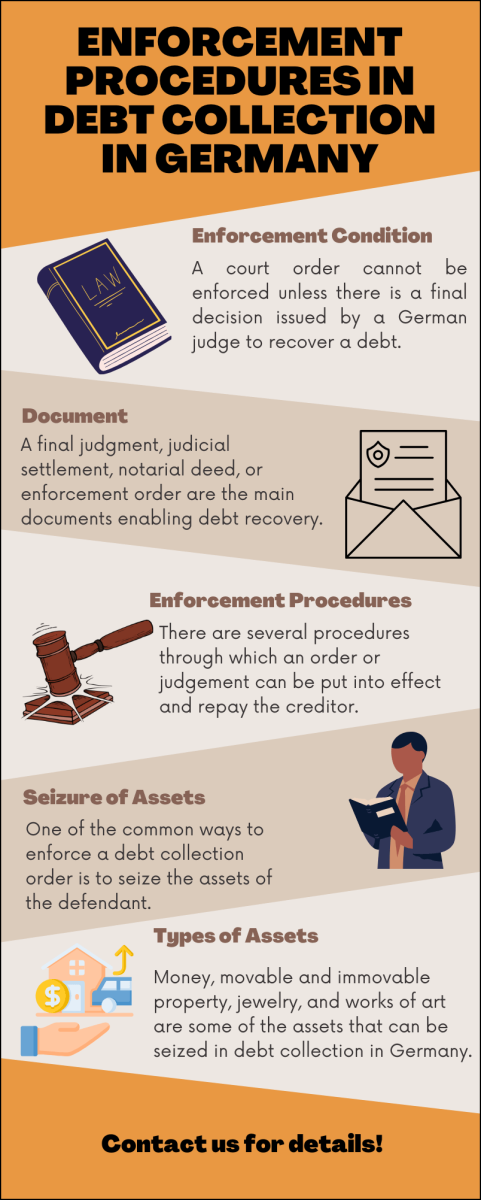
Here is also our infographic on this subject:
Authorities involved in the enforcement of German court orders
Due to the fact that compulsory enforcement implies several measures, after the order is issued by the court (the main body involved in the procedure) it should be noted that there are also secondary organizations, such as:
- the Land Register (which refers to the mortgage phase);
- banks where the freezing of assets held in bank accounts is ordered;
- the bailiff who has the authority to enforce the order.
You can rely on our lawyers if you need more information the debt recovery procedure in Germany.
Enforcement of court orders issued by foreign judges
Foreign claimants who have to recover debts registered in Germany can also address German courts under the following laws:
- the Brussels Regulations that apply at EU level
- through multilateral international treaties such as the Lugano Convention and the Hague Convention;
- bilateral agreements that Germany has with countries such as Israel and Tunisia (for the UK, the 2019 Hague Judgments Convention also applies to proceedings started on or after 1 July 2025).
Recognition vs. enforcement of a court decision in Germany
Court decisions issued in civil and commercial disputes, debt collection included, can be recognized and enforced in Germany. However, they are two different procedures. Recognition refers to the effect a foreign judgment has, while enforcement provides for the actual execution of the respective decision.
For a foreign court decision to be enforced in Germany, it must, unless it comes from an EU member state (Brussels Ia), be declared enforceable by a competent German court, in accordance with Section 722 in the Civil Procedure Code. Recognition, on the other hand, does not need to be acknowledged under the national legislation. It must be noted, though, that there is a connection between the two terms when it comes to foreign judgments, as, outside the Brussels Ia regime, they must be declared enforceable before execution.
If you have a debt-related court order and need to have it enforced, you can rely on our debt collection lawyers in Germany for guidance.
Can court orders be challenged in Germany?
Yes, court orders can be challenged in accordance with the grounds specified by Section 328 in the Civil Procedure Code. There are multiple reasons that can lead to contestation; however, the most important one refers to the violation of the fundamental rights of the defendant. This means that an order cannot be enforced by a German court if it does not comply with the provisions of the said Section 328.
If you consider you have the grounds to challenge such an order, we invite you to ask for information from our German debt recovery lawyers, who can offer specialized advice.
How long does it take to enforce a court order in Germany?
The timeframe in which a court order can be enforced in Germany depends on the legislation or treaty it abides by. As such:
- under the Brussels Regulations, orders are enforced relatively rapidly, as there is no need to submit an enforceability declaration (about 2 to 4 months);
- in accordance with the Lugano Convention, it may take a few weeks (around 2 months, usually) for an order to be enforced, as the German court must issue an enforceability declaration;
- under other treaties, the enforcement may take between 4 and 8 months;
- under the national legislation, the enforcement may take longer (about one year), as an action for an enforcement judgment must be brought before the competent local or regional court (Sections 722-723 ZPO).
Also, please note that there are no summary proceedings when it comes to enforcing foreign-issued judgments.
Here is also a video on this subject:

Debt collection statistics in Germany
According to the Creditreform SchuldnerAtlas 2025:
- approximately 5.67 million adults in Germany were over-indebted, the first notable increase since 2018;
- 8.16% of adults are over-indebted;
- also, 1 in 3 persons has one or more credits.
If you need support with the procedure of enforcing court orders in Germany, please refer to our debt collection lawyers.