22 September 2026
Seizure of Assets in Germany
Details about the process of seizure of assets in Germany. Contact us if you need debt collection services in Germany!

Seizure of assets in Germany is the procedure that entails the recovery of a debt when the amicable process fails. Should you need support in such a case, our debt collection lawyers can advise and offer tailored assistance no matter the side you are on.
| Quick Facts | |
|---|---|
| Legislation applicable | German Code of Civil Procedure (Zivilprozessordnung – ZPO) |
Possibility to dispose seizure of assets through amicable debt recovery (YES/NO) | No, it is not possible to seize assets through an amicable procedure |
Seizure of assets step in the debt collection procedure | The seizure of goods is one of the final steps in debt recovery in Germany |
| Party initiating the seizure of assets | The creditor must file a complaint with a German court in order to recover an outstanding amount of money for which the seizure of goods can be disposed |
| Types of enforcement procedures | The type of enforcement procedures can imply attachment, lien or arrest of the debtor |
| Possibility to seize movable goods (YES/NO) | Yes, this is the correspondent of the lien enforcement of debt collection in Germany |
| Possibility to seize immovable goods (YES/NO) | Yes, immovable assets can be seized by means of attachment in Germany |
| Option to dispose the seizure of money in bank accounts (YES/NO) | YES, bank account balances can be garnished by court order, subject to the protected amount on a garnishment-protection account (P-Konto) |
| Restrictions on enforcement of court orders (YES/NO) | YES, there are also goods that cannot be seized by court order |
| Restrictions on the seizure of certain assets (if any) | Personal assets, such as clothing articles and goods that ensure the minimum living conditions for the debtor cannot be seized |
| Type of German court issuing seizure orders | Local and district courts can issue seizure orders in Germany |
| Requirement to appoint a bailiff (YES/NO) | YES, the creditor instructs the court bailiff (Gerichtsvollzieher), a state official who seizes and sells movable assets; garnishment of claims is ordered by the enforcement court |
| Possibility to sell seized assets to recover a debt (YES/NO) | YES, the goods retained can be sold to recover the debt |
| Options to avoid the seizure of debts in Germany | Amicable debt collection and agreements with the creditors can be used in order to avoid the seizure of assets in Germany |
| Debt collection services available (YES/NO) | YES, we can advise debtors and creditors during the procedure of debt collection in Germany |
| Enforcement authority | Court appointed |
Assets | Most type of assets including buildings and cars. |
Execution title | A court judgment or an enforceable order, is required for the seizure of assets in Germany |
| Notification to debtor per German regulations | The enforceable title must be served on the debtor before enforcement begins (Section 750 ZPO), but the debtor is not heard before a garnishment order is issued (Section 834 ZPO). |
| Public auction | Public auctions are held to sell the seized assets. |
| Debt collection costs | Debtors might need to pay for the expenses related to the seizure of assets. |
| Third-party claims | Third parties can file claims against seized assets if they have a legal interest involved. |
| Exemptions from seizure | Income (including pensions) below the statutory garnishment exemption limits, certain social and insurance benefits, and more. |
| Inventory of assets | May be required to identify items eligible for seizure. |
| Appeals process | Debtors have the right to appeal the seizure of their assets with the help of our German debt collection lawyers. |
| Garnishment orders | Wages and salaries can be garnished to satisfy debt obligations. It can happen if the assets of the debtor are not seized. |
| Time limit for enforcement | Claims confirmed by a final judgment, enforcement order or enforceable deed can be enforced for 30 years (Section 197 BGB); attachment (arrest) orders must be executed within one month (Section 929 ZPO). |
| Debt repayment plan | Debtors may negotiate repayment plans to avoid asset seizure in Germany. Such planning needs the approval of the creditor. |
| Enforcement discretion | Enforcement officers have discretion in choosing which assets to seize. |
| Professional assistance | We provide assistance for both legal procedures in order to seize assets as part of debt collection procedures as well as legal assistance if you have been sued for an outstanding debt. |
What stage does the seizure of assets represent in a debt collection case in Germany?
The seizure of assets is usually the last step in debt recovery in Germany, so to get there you must pass through several other procedures.
What are the grounds for seizing a debtor’s assets in Germany?
The first and most important one refers to the solid grounds for the confiscation of assets to be allowed. In this case, the creditor must prove the existence of the debt.
In case all the assets of the debtor are to be seized, the creditor must prove that the debtor is dishonest about their intention or plan to bypass the execution of the German court’s order.
What are the measures taken in seizure of assets proceedings in Germany?
The measures which can be taken when recovering debt in Germany are:
- the pre-judgment seizure of the debtor’s assets and up to the arrest of the defendant;
- an interim injunction under Section 935 of the Code of Civil Procedure which can provide for the defendant to not be allowed to use the assets;
- the notice of imminent attachment of a debt under Section 845 of the Code of Civil Procedure in Germany;
- the enforcement of provisionally enforceable judgments covered by Section 708 of the Code of Civil Procedure;
- under EU regulations, German courts can also acknowledge and provide for the enforcement of court decisions issued by EU courts.
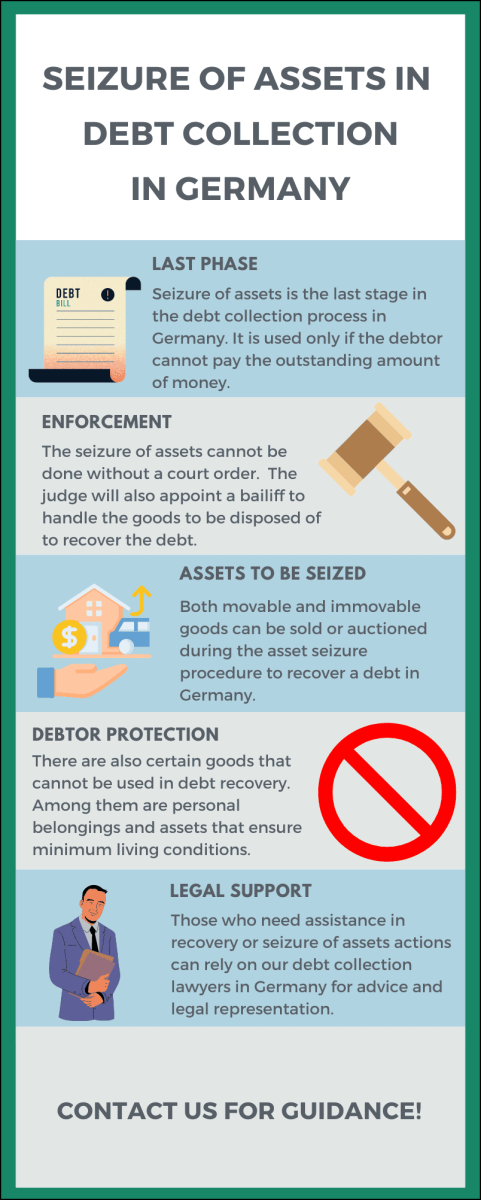
Here is also an infographic on this subject:
When can a seizure of assets order be imposed in Germany?
Strictly related to debt collection cases, the seizure of assets is imposed when there are grounds to believe that the debt cannot be recovered in another way.
What are the steps completed in a seizure of assets case?
German courts of law provide for a 2-step seizure of assets procedure:
- the attachment order or arrest order, which is a procedure through which assets and other properties are frozen before a final judgment is issued;
- the attachment or garnishment procedure, which implies the enforcement of the decision through which the debtor’s assets are executed.
What types of assets can be subject to seizure in a debt recovery case in Germany?
- bank accounts;
- income from employment;
- real estate and other physical goods of the debtor.
Are there any assets that cannot be seized in a debt collection procedure in Germany?
Yes, the goods mentioned below cannot be attached:
- goods that ensure a reasonable living for the debtor and for his family;
- goods that, by selling, have no value;
- inalienable goods as they are closely associated with the debtor’s personality;
- incomes and wages of minors
- unpublished art, such as books, music, paintings
- the amount of money earned by prisoners from prison jobs;
- maintenance payments for the non-culpable spouse, as provided by the court
- a minimum amount of income to ensure a modest lifestyle for the debtor and his family
What is the timeframe to enforce a seizure of assets order in Germany?
One month.
NOTE: Many creditors ask for specialized support from our debt collection lawyers in Germany to ensure the effectiveness of the order.
We also invite you to watch our video below:

Is it possible for foreign judgments to also impose the seizure of assets in Germany?
Yes. A foreign judgment can be enforced against a debtor with assets in Germany, regardless of nationality. In this case, the procedure depends on the country of origin (Brussels Ia, Lugano Convention or Section 722 ZPO).
What are the effects of a seizure of assets order in Germany?
The main effects of a seizure of assets order are:
- the debtor can no longer use the assets executed under the order issued by the court;
- third-party debtors will also lose their rights to use or dispose of the assets under the order (where such debtors exist);
- the assets seized are protected against destruction under Section 136 of the Criminal Code;
- within one month from the issuance of the judgment, the creditor can apply for the enforcement of the seizure of assets order;
- the creditor is also entitled to apply for an arrest or interim judgment order pursuant to a trial;
- with respect to interim injunctions, the bailiff can complete the order to seize the assets, in accordance with Section 883 of the Civil Procedure Code.
If you need assistance in debt collection and seizure of assets cases in Germany, do not hesitate to contact our lawyers.