10 March 2026
Amicable Debt Collection in Germany
How amicable debt collection works in Germany: open communication and negotiation to reach an agreed solution without going to court. Contact our team.
Unlike confrontational methods, amicable debt collection in Germany seeks to foster open communication and negotiation to achieve a mutually agreeable resolution. This approach recognizes the complexities of financial matters and aims to find solutions that benefit both parties while avoiding the need for legal action. With the legal help of our lawyers, explore how this collaborative method unfolds in the context of debt recovery in Germany within the legal framework.
| Quick Facts | |
|---|---|
| Legal framework | Governed by German civil law and consumer protection laws. |
Communication process | Initial contact through letters or phone calls to debtors. |
Negotiation | Negotiations often involve repayment plans or settlements. |
| Mediation services | Mediators may be engaged for complex debt disputes. |
| Consumer rights | Debtors have rights, including protection from harassment. |
| Financial hardship consideration | Debtors facing financial hardship may be offered leniency. |
| Documentation | Detailed records of communication and agreements are kept. |
| Compliance with regulations | Agencies must adhere to German and EU debt collection laws. |
| Language considerations | Communications often conducted in German but may offer translations. |
| Timeframe for resolution | Amicable resolutions can vary in time, depending on negotiations. |
| Legal action as last resort | Legal action pursued if an amicable resolution fails. |
| Debt verification | Debtors have the right to request verification of debts. |
| Confidentiality | Privacy of debtor information is protected by law. |
| Debt settlement options | Options may include lump-sum payments or installment plans. |
| Cross-border debt collection | EU regulations apply for cross-border debt collection. Our debt collection lawyers in Germany can assist you in such cases. |
The pre-collection phase in Germany
When dealing with a debtor, the first stage in the recovery of a debt is sending a demand letter, where the debtor is informed about:
- the outstanding amount of money;
- the due term and the fact that it expired;
- the new payment term.
It is possible for a debtor to receive more than one dunning letter; however, in most cases, if the money is not repaid, the amicable debt recovery begins. The pre-collection step is completed by the creditor in an attempt to recover the money as soon as possible. However, our debt collection lawyers in Germany can help you at this stage if you want to avoid lengthier procedures.
Steps for amicable debt collection in Germany
After the pre-collection step, the amicable debt recovery procedure is taken over by a specialized agency or law firm, which will take the following stages:
- contacting the debtor via phone and or mail (email included) several times;
- negotiating with the debtor after receiving a response from him/her/it;
- reaching an agreement and drawing up a new payment document.
With respect to a new payment agreement, even if it can be concluded verbally, it is worth noting that it is best to have it in writing and signed by the debtor and the collecting party. Also, the creditor must agree to the new terms.
The contract may contain provisions on the new amount to be paid, as well as other payment dates other than the initial one.
If you need assistance in drawing up such a document, our lawyers who specialize in debt collection in Germany can assist you. They can also explain the new terms to the debtor for full transparency.
Amicable debt collection procedure in Germany
The procedure for amicable debt collection in Germany typically begins with a formal communication from the creditor or their legal representative, often our lawyer, to the debtor. This initial contact outlines the details of the debt, including the amount owed and the reasons for the outstanding payment.
Amicable debt collection in Germany is a process that prioritizes cordial and cooperative approaches to resolving outstanding debts between creditors and debtors. The debtor is given an opportunity to discuss their financial situation, and both parties work towards finding a mutually acceptable resolution. This may involve proposing a reasonable repayment plan, negotiating adjustments to the debt, or exploring alternative arrangements.
Throughout this process, our lawyers engaged in amicable debt collection in Germany must adhere to strict ethical standards, consumer protection laws, and data privacy regulations. The goal is to reach a fair and voluntary agreement without resorting to legal action, preserving a positive relationship between the parties whenever possible. Our experienced lawyers are here if you are seeking help regarding debt collection in Germany.
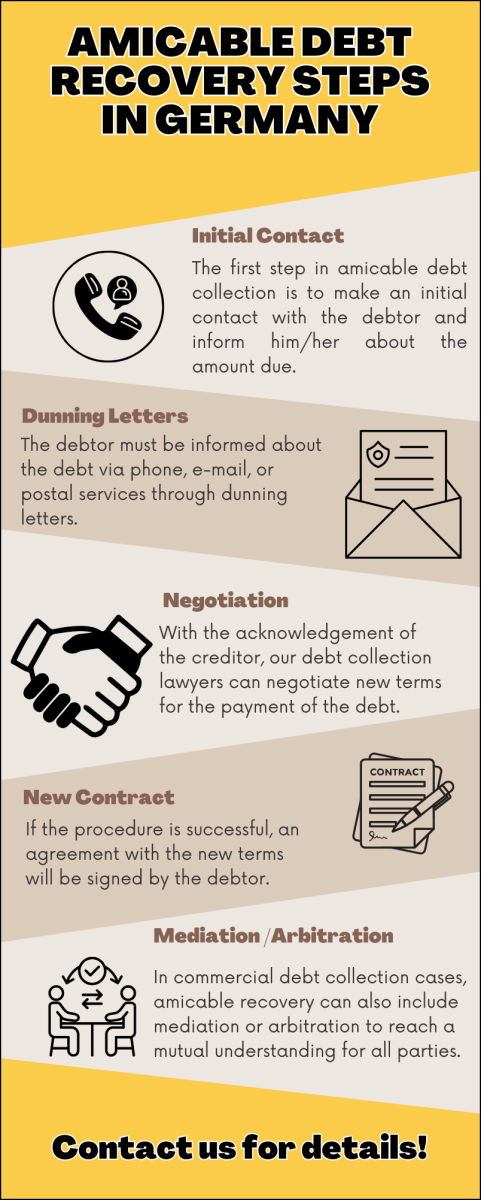
Here is also an infographic on this topic:
Regulations for amicable debt collection in Germany
In Germany, lawyers conducting amicable debt collection are subject to regulations and ethical considerations that govern their actions. While amicable debt collection in Germany focuses on cooperative and non-confrontational methods, lawyers must adhere to certain restrictions and guidelines:
Professional conduct:
– Our lawyers are bound by professional conduct rules, and they must maintain high ethical standards in their interactions with debtors;
– They are prohibited from engaging in deceptive, misleading, or aggressive practices during the process of debt recovery in Germany.
Data protection laws:
– Germany has stringent data protection laws, and our lawyers must ensure compliance with regulations such as the General Data Protection Regulation (GDPR) when handling and processing debtor information.
Consumer protection laws:
– German amicable debt collection involving consumers is subject to consumer protection laws. Our Lawyers must adhere to these regulations to ensure fair and transparent communication with debtors. If you are seeking professional legal services for the collection of debt in Germany, the services of our lawyers are at your disposal.
Fair debt collection practices:
– Our lawyers must follow fair debt collection practices outlined in various consumer protection laws. These practices include providing accurate information about the debt, respecting the debtor’s privacy, and avoiding harassment.
Cease requests:
– Debtors in Germany have the right to issue cease requests, requiring lawyers to stop certain communications or actions. Our German lawyers comply with these requests to avoid legal consequences.
Alternative dispute resolution:
– German law encourages alternative dispute resolution methods. Our lawyers may be required to inform debtors about mediation or arbitration options as alternatives to legal action.
It’s crucial for our lawyers engaged in amicable debt collection in Germany to stay informed about the latest legal developments and adhere to the ethical standards set by their professional bodies. Additionally, maintaining a balanced and cooperative approach is essential to achieving successful outcomes while respecting the rights and dignity of debtors.
Raising default action and objection
Opting for a default action is considered a quicker and more effective way to enforce a financial claim compared to filing a traditional lawsuit. Please find some information about raising a default claim and objection to it:
- The court dunning procedure (Mahnverfahren) is a legal process in civil court to enforce a monetary claim against a debtor who has defaulted on payment. This process is regulated by section 688 of Zivilprozessordnung (ZPO);
- The debtor has the right to object to the payment order (Mahnbescheid) in writing under section 694 ZPO. The objection period is two weeks from the date the order for payment is served (section 692 (1) No. 3 ZPO);
- For cases involving service abroad, the objection period is extended to one month (section 32 (3) AVAG). If the debtor raises a timely objection, the court cannot issue an enforcement order.
Can a debtor initiate the collection procedure?
While this is not a common practice, it is not unusual for a person or company that knows he/she/it is in incapacity to ask for representation to reach an agreement with a creditor.
Our debt recovery lawyers in Germany also encourage people and businesses to try to extinguish outstanding debts if they see a pattern in delaying or not making any payments at all, and constant pressure from creditors. This way, they will show goodwill and, most importantly, avoid interest adding up to the initial sum.
Here is also our video on this subject:
How long does amicable debt recovery in Germany take?
German amicable debt recovery procedures are the easiest to settle and the shortest to complete. Depending on how soon the debtor answers, you can expect:
- for an agreement to be reached in 3 to 4 weeks;
- for the debtor to start paying with the following month or even sooner.
It is also important to note that missing a payment term implies a violation of the new debt recovery settlement.
If you are interested in amicable debt collection in Germany, please contact us.